



If you’ve ever watched a dog you love struggle to stand up, you know the particular kind of helplessness that comes with it.
Tasha was my first dog as an adult. A German Shepherd, brought home in 2001 when I was twenty-six and pretty sure I knew exactly what I was doing. (Spoiler: I did not.)
She was my shadow for years. The kind of dog who followed me from room to room, waited outside bathroom doors, slept right next to me on the bed. Then, somewhere around year ten, she started doing this thing in the mornings where she’d get up from her bed in stages. Front legs first. Pause. Back legs. Pause. A little shake, like she was trying to convince herself she was fine. By year 11, she couldn’t jump up on the bed at all anymore.
My vet put her on Rimadyl. It helped for a while. Then it didn’t. Then we tried something else. Then that stopped working too. Nobody ever really explained why. Just that arthritis progresses, this is what happens, here’s the next thing we can try. We finally let her go in early 2016, just a few months before her 15th birthday. A long life for a GSD, I know, but it’s still never enough time, is it?
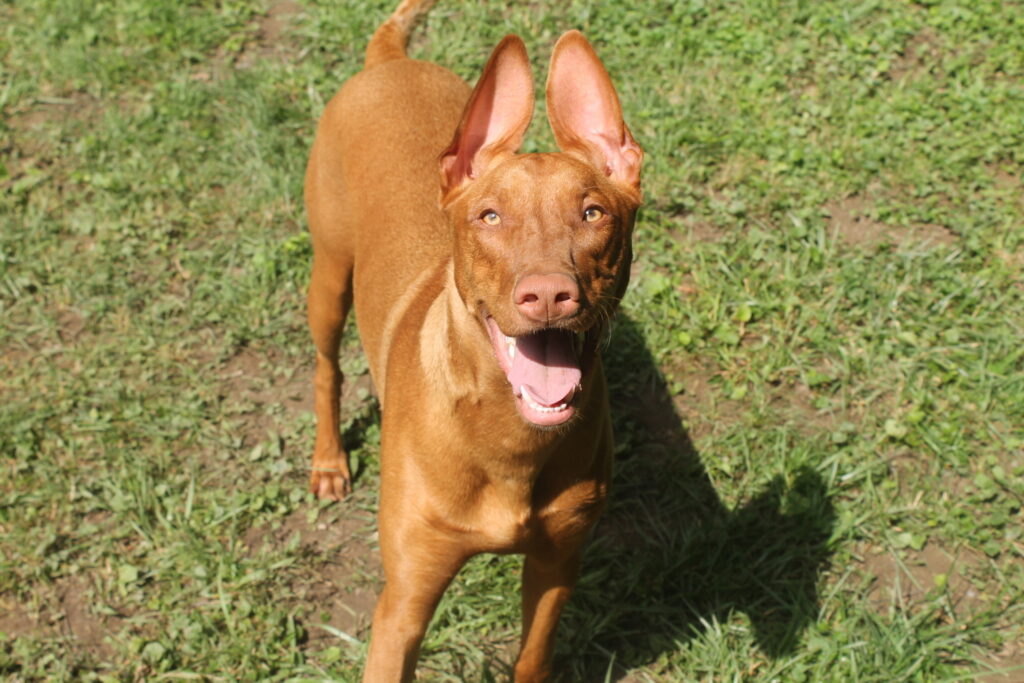
I thought about Tasha a lot last year when Freya started favoring her left hip after our longer walks.
If you’re reading this, there’s a decent chance your dog is somewhere in that same cycle. Medication that worked, then didn’t. A vet who’s doing their best but keeps recommending the next thing. A monthly bill that’s climbing. And a dog who still isn’t comfortable.
Here’s what I wish someone had explained to me years ago. Here’s what finally made the difference.
The short version:
- Rimadyl, Previcox, and other prescription NSAIDs suppress inflammation, but they don’t replace the cartilage that’s actually deteriorating.
- That’s why they work, then stop: the underlying problem keeps getting worse while the medication tries to keep up.
- The fix is giving joints what they need to rebuild: glucosamine at a real therapeutic dose, hemp oil for the specific inflammatory pathway involved in joint degradation, and collagen for connective tissue.
- Most supplements don’t deliver enough of any of these to matter, but Vet Naturals Hemp & Hips is one that does, at doses that are actually transparent on the label.
- Real owners report visible improvement in 2-3 days, much faster than the 60-day timeline most brands promise.
Why Your Dog’s Joint Medications Keep Stopping Working
Here’s the thing no one tells you at the vet’s office, at least not in plain English.
Dogs produce their own glucosamine up until around age two. After that, production slows significantly. For large and giant breeds like German Shepherds, Labradors, Golden Retrievers, Rottweilers, and Great Danes, it slows even faster because of the structural demands their size puts on those joints. As glucosamine production drops, cartilage starts to thin. The bones lose their cushion. The joint becomes inflamed. The immune system responds. That’s what the pain is.
Prescription NSAIDs like Rimadyl and Previcox are designed to quiet that inflammatory response. And they do, for a while. The problem is they’re only addressing the symptom. They are not replacing the cartilage that’s continuing to thin underneath.
So the joint keeps degrading while the medication tries to keep up. Which is why it works for six months, then loses effectiveness. Why the dose keeps needing to increase. Why you eventually find yourself on something stronger, then something stronger again.
Think of it this way: it’s like silencing the fire alarm while the building keeps burning. The alarm stops ringing. The problem does not stop happening.
I know this is not a cheerful thing to read. But understanding why this happens is what finally pointed me toward something that actually worked.
The Other Problem With Long-Term NSAID Use
Beyond the cycle of diminishing returns, there’s a practical concern that owners on long-term prescriptions know all too well: the bloodwork.
Rimadyl and Previcox are hard on the liver. Prolonged use requires regular blood panels to monitor for liver damage, a genuine medical necessity, not a precaution your vet is upselling you on. Those panels add up. When you factor in the cost of a prescription plus quarterly bloodwork, you’re looking at $300 to $400 or more per month for some large breed owners.
I’ve seen dog owners do this math in Amazon reviews, Reddit threads, and Facebook groups, often with the kind of exhausted clarity that comes from years of it. One reviewer put it like this:
“Even with daily dosing, the cost for Hemp & Hips for both dogs is not much more than rationing the Previcox to one, especially if you factor in a blood test to check for liver damage.”
That’s a real owner doing real math. And they’re not wrong.
One More Thing I’m Watching With Freya
There’s another wrinkle I didn’t have to worry about with Tasha, but I do with Freya.
Some breeds metabolize medications very differently than others. Pharaoh Hounds, like greyhounds and other sighthound relatives, have lower body fat and different liver enzyme activity than your average Lab or German Shepherd. That changes how drugs move through their system, how long the drugs stay there, and how the body clears them out. The same standard dose that’s fine for a Golden can sit longer, build up, and hit harder in a sighthound.
I learned this the hard way years ago when Freya had a bad reaction to Benadryl. Freya had gotten in a fight with a wasp and lost. Most dogs tolerate it without a second thought. She did not. Since then I’ve been cautious about anything she might take regularly, especially long-term prescription medication that comes with built-in liver concerns to begin with.
It’s not that NSAIDs are off the table for her. It’s that the risk math looks different than it would for Tasha. If we ever do go that route, it will be with a vet who knows sighthound metabolism, careful dosing, and a real plan for monitoring. But if I can find something that works without putting her there in the first place, that’s the path I’d rather take.
| 💡 Pro TipIf you have a sighthound, a sighthound mix, or any breed known to metabolize drugs differently (Collies, Australian Shepherds, and other herding breeds with the MDR1 mutation also count), tell your vet before any long-term NSAID conversation starts. Dosing protocols for these breeds are genuinely different, and the standard chart in the back of the prescription book is not always the right starting point. |
What Actually Helps: The Three-Ingredient Framework
A vet tech I interviewed while researching this piece laid it out simply. To stop the cycle, rather than just slow it, you have to give the joints the raw materials they need to maintain themselves. That means three things working together:
1. Glucosamine at a therapeutic dose
This is the foundational ingredient in any serious joint supplement. The keyword is dose. Many joint supplements contain glucosamine, but at amounts too low to make a measurable difference. Look for at least 400mg per serving. Anything listed inside a “proprietary blend” without a disclosed amount is a flag. You genuinely don’t know what you’re getting.
2. Hemp oil (not CBD) for the inflammatory pathway
Hemp seed oil provides Omega-3 and Omega-6 fatty acids that target the specific inflammatory pathway involved in joint degradation. This is different from CBD. Hemp seed oil contains no cannabinoids, but the Omega fatty acid content has a real, documented effect on systemic inflammation. The key is the dose and the quality. Most supplements that list “hemp oil” are using trace amounts. Enough to put it on the label; not enough to matter.
3. Collagen for connective tissue
Cartilage, tendons, and ligaments are primarily made of collagen. Supplementing it gives the body material to work with when maintaining and repairing those structures. This is the ingredient most commonly missing from standard glucosamine supplements, and the one that makes the multi-ingredient approach meaningfully different from a single-ingredient chew.
One more thing: the format matters. Pills and standard hard chews have notoriously poor absorption in older dogs with slower digestive function. A soft chew delivers these ingredients in a more bioavailable form, which is partly why some owners report results faster than they expected.
| 💡 Pro Tip If your dog is a senior with missing teeth or dental sensitivity, soft chews are also gentler on the mouth than hard tablets, a genuine functional advantage that most brands, and most owners, overlook. |
What I Found When I Started Looking
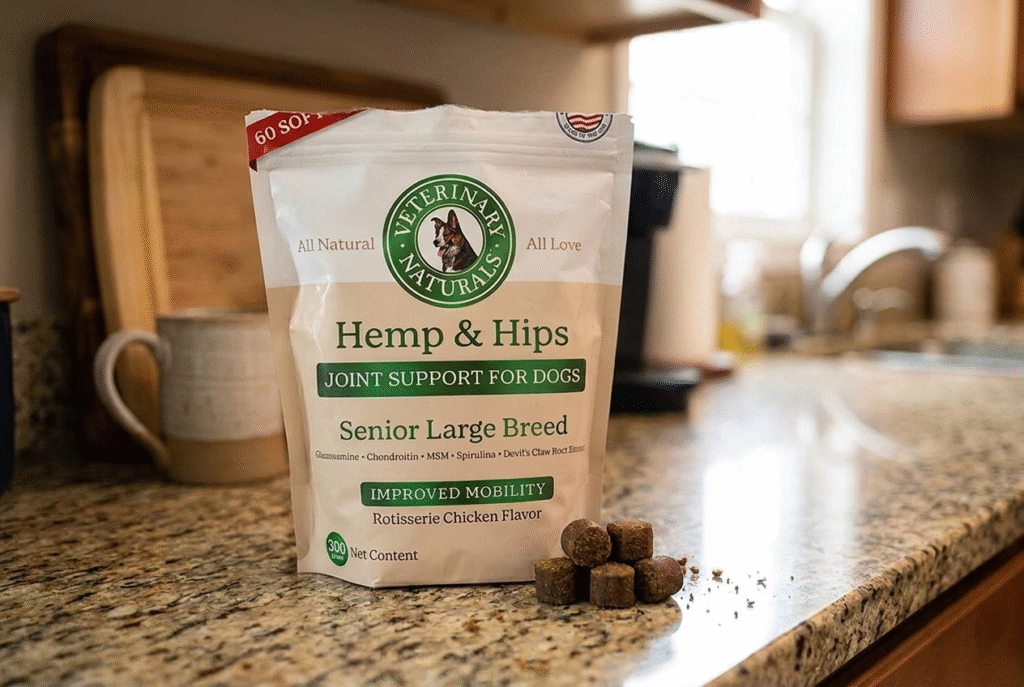
When I started researching options for Freya, and thinking back to what I wish I’d had for Tasha, I kept running into the same brand in dog owner communities: Vet Naturals Hemp & Hips.
It wasn’t something I found through an ad. It was something that kept appearing in threads where someone asked “which supplement actually does what it says?” The kind of question people only ask when they’ve already been burned by something else.
What made it credible to me was the transparency. Glucosamine at 450mg per chew. Hemp oil and collagen listed with actual amounts. Made in the USA, vet-formulated, grain-free. No proprietary blend obscuring the dosage. The formula isn’t hiding anything, and in a supplement category that’s genuinely full of products hiding everything, that means something.
Vet Naturals Hemp & Hips at a Glance
| Product | Vet Naturals Hemp & Hips Joint Supplement |
| Form | Soft chew |
| Glucosamine | 450mg per chew |
| Key ingredients | Glucosamine, Hemp Oil, Collagen, MSM, Turmeric |
| Available flavors | Beef & Bacon / Chicken |
| Size options | Regular / Senior Large Breed / Senior Small Breed |
| Made in | USA |
| Best for | Senior dogs, large breeds, post-surgery recovery |
| Approx. cost | Around $31 to $36 per month on subscription |
What Dog Owners Actually Report
I spent time reading through reviews across Amazon, Chewy, and the brand’s own site, a few thousand of them. The patterns that emerged were consistent enough to be meaningful.
The speed of results surprised nearly everyone.
The brand’s own packaging suggests giving it 60 days. But owners writing their first reviews were consistently reporting visible improvement in 2-3 days, not weeks. The most commonly shared story: a dog who was getting up in stages or refusing walks was moving noticeably more easily within the first week.
“She hadn’t been doing these things for some time: running, jumping on us, putting her paws on the counter. After a few days, she was back.” (Amazon, Golden Retriever owner, 8.5 years)
“He bounces and prances and runs like a puppy. He craves these like hard drugs now.” (Amazon, 11-year-old Mini Pinscher, Beef & Bacon flavor)
“Within just one week, after chondroitin, glucosamine, Rimadyl, and other types of meds the veterinarians prescribed didn’t help at all.” (Amazon, 10-year-old Shih Tzu)
For senior dogs in more acute pain, the ones where owners describe thinking they might be approaching the end, those were the cases with the most dramatic turnarounds.
Long-term users tell a different, equally important story.
The early reviews capture transformation. The reviews from owners who’ve been using Hemp & Hips for six months to two years capture something else: the absence of decline.
Near-zero flare-ups compared to before. Vets surprised at mobility during annual checkups. Senior dogs keeping up with walks they’d been missing. The product becoming something owners describe as genuinely distressing to run out of, because the regression when doses are missed is noticeable within a day or two, which is its own kind of evidence that it’s working.
Something unexpected: the anxiety angle.
I hadn’t expected to find this, but multiple reviewers independently described Hemp & Hips reducing their dog’s anxiety around storms and fireworks as a secondary benefit they hadn’t been looking for. One reviewer described getting through New Year’s without the valium they’d needed previous years. Another noted that a dog with severe storm anxiety was calmer after several weeks on the supplement.
This makes biochemical sense. The hemp oil’s Omega content has systemic anti-inflammatory and calming properties, but it’s a benefit the brand itself has barely promoted. For owners managing both joint pain and anxiety in a senior dog, it’s worth knowing.

