




Lemonade and Trupanion both offer pet insurance for unexpected accidents and illnesses, but beyond that basic similarity, they work pretty differently.
For most pet owners, Lemonade is our top choice. It gives you far more flexibility to build a policy around your budget, offers optional coverage that Trupanion doesn’t, and uses a straightforward annual deductible rather than charging a separate deductible for every new condition your pet develops.
Trupanion does have two advantages: unlimited payouts (but with a heavy side of caveats) and the ability to pay participating veterinarians directly (again, with caveats). Those are worth considering, particularly if you’re primarily looking for protection against extremely expensive or long-term medical problems.
So, this isn’t a case where Trupanion is a bad option. We just think Lemonade offers a better balance of coverage, flexibility, and everyday value for most dogs and cats.
|
WINNER

|

|
|
Fast, app-based insurance with some of the lowest starting premiums, especially for younger pets. |
Unlimited coverage with a simplified plan structure, built for major and long-term medical costs. |
Fast, app-based insurance with some of the lowest starting premiums, especially for younger pets.
Unlimited coverage with a simplified plan structure, built for major and long-term medical costs.
Lemonade vs. Trupanion at a Glance
| Feature | Lemonade | Trupanion |
|---|---|---|
| Accident & illness coverage | Yes | Yes |
| Reimbursement | 70%, 80%, or 90% | 90% |
| Deductible type | Annual | Lifetime per condition |
| Deductible options | $100–$750 | $0–$1,000 |
| Annual coverage limit | $5,000–$100,000 | Unlimited* |
| Preventative/wellness coverage | ✓ Optional | No |
| Vet visit fee coverage | ✓ Optional | No |
| Dental coverage | ✓ Optional | Eligible dental illness/injury |
| Behavioral treatment | ✓ Optional | Optional rider |
| Physical/rehab therapy | ✓ Optional | Optional rider |
| Puppy/kitten preventative care | ✓ Available | No |
| Multi-pet discount | ✓ Yes | No standard discount |
| Bundling discount | ✓ Yes | No |
| Annual payment discount | ✓ Yes | No |
| Mobile app | ✓ Yes | No |
| Direct vet payment | No | ✓ Yes, at participating vets |
| Accident/injury waiting period | 0 days | 5 days |
| Illness waiting period | 14 days | 30 days |
Coverage options, limits, discounts, waiting periods, and availability may vary by state and policy. Always review the current policy terms and your individual quote before enrolling.
Tip: While Trupanion’s unlimited payouts sound great upfront, keep in mind that you will have to pay a deductible for EVERY SINGLE DIFFERENT issue vs Lemonade where you just pay one deductible per policy year.
Why Lemonade Is Our Top Pick
The biggest reason we prefer Lemonade isn’t one flashy feature. It’s that you have considerably more control over what you’re buying.
Pet insurance is one of those things where “more coverage” doesn’t automatically mean “better insurance.” A policy also has to fit your budget well enough that you can afford to keep it year after year.
That’s where Lemonade has a pretty substantial advantage.
1. Lemonade Gives You More Ways to Customize Your Policy
With Lemonade, you aren’t locked into one reimbursement percentage or one level of coverage.
Depending on what’s available in your state, you can choose your reimbursement percentage, annual deductible and annual coverage limit. Lemonade currently offers reimbursement levels of 70%, 80%, and 90%, with annual coverage limits ranging from $5,000 to $100,000.
That flexibility matters because not everyone buys pet insurance for the same reason.
Maybe you want fairly inexpensive coverage that’s primarily there to keep a $10,000 emergency from turning into a financial disaster. Or maybe you’re willing to pay a higher monthly premium for 90% reimbursement and a higher annual limit.
Lemonade lets you make those decisions.
Trupanion takes a much more standardized approach. Its core plan reimburses 90% of eligible veterinary expenses after the applicable deductible and has unlimited payouts.
There’s certainly something to be said for simplicity, but we prefer having more control over the price and coverage.
2. Lemonade Uses One Annual Deductible
This is one of the most important differences between Lemonade and Trupanion, and it’s also one of the easiest to misunderstand.
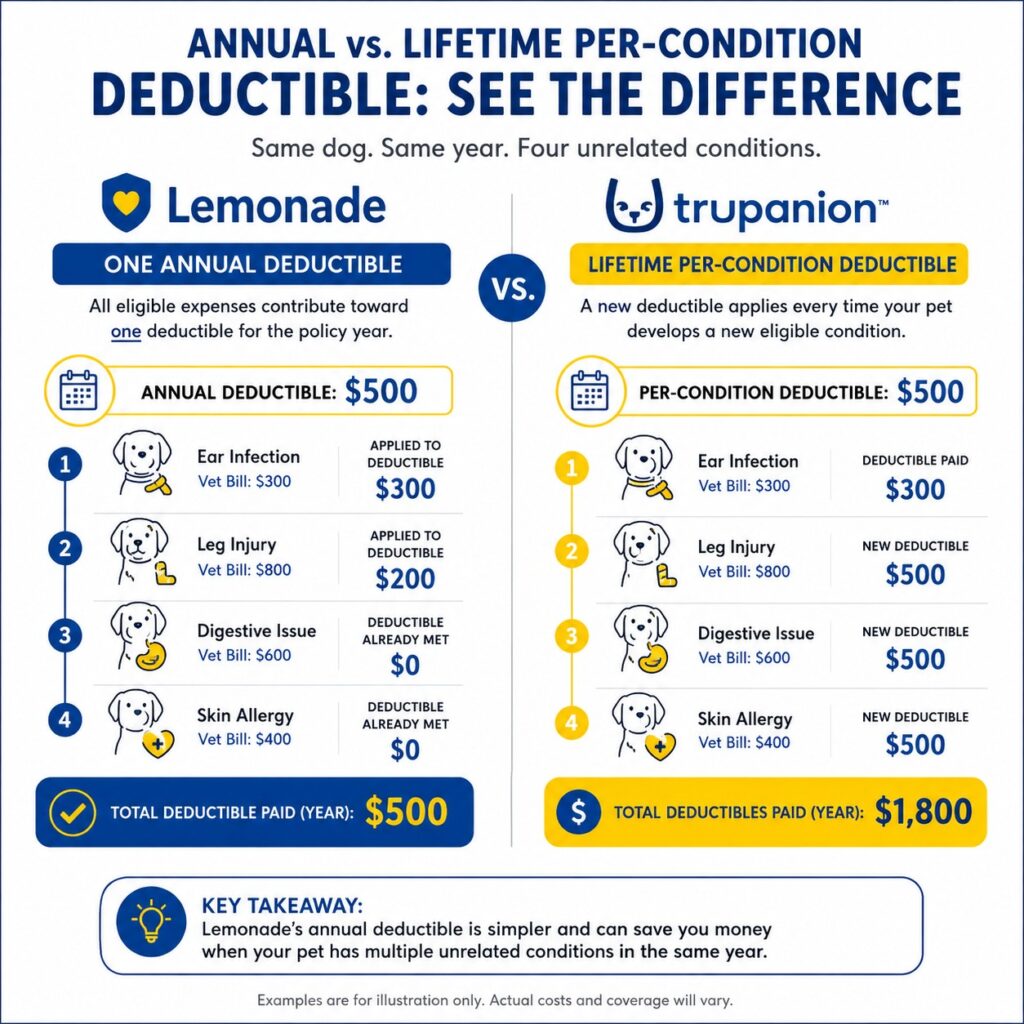
Lemonade uses an annual deductible. Once eligible expenses have satisfied that deductible, you don’t have another deductible to meet every time your pet develops a different medical problem during the same policy year. The deductible resets when the policy renews.
Trupanion uses a lifetime per-condition deductible. You have to meet a separate deductible whenever your pet develops a new covered condition. Once you’ve met the deductible for that particular condition, however, you never have to meet it again for that condition.
Let’s say you chose a $500 deductible.
Your dog has an ear infection in February, injures his leg in May, develops an unrelated digestive problem in August, and needs treatment for another new condition in November.
With Lemonade, those eligible expenses all contribute toward the same $500 annual deductible.
With Trupanion, each new condition can have its own $500 deductible.
That could mean considerably more out-of-pocket spending during a year when your pet develops several unrelated health problems.
There is a flip side, though. If your pet develops one expensive chronic condition that requires treatment for years, Trupanion’s deductible can work beautifully. Once you’ve met the deductible for that condition, it’s gone for the life of your pet.
So, we’d call this one Lemonade for simplicity and multiple unrelated conditions, Trupanion for long-term chronic conditions.
For the average pet owner, though, we prefer the predictability of one annual deductible.
3. Lemonade Offers Preventative Care
Traditional pet insurance is designed primarily for the unexpected. Unfortunately, your veterinarian still expects to be paid during those boring years when nobody swallows a sock.
Lemonade gives you the option to add preventative care coverage for some of the routine expenses you’re already paying.
Depending on the package and your location, preventative coverage can help with expenses such as wellness exams, vaccinations, bloodwork, heartworm or FeLV/FIV testing, fecal testing, and other routine care. Lemonade also offers puppy and kitten preventative options that can include additional early-life expenses.
Preventative coverage isn’t subject to Lemonade’s regular annual deductible, and benefits can begin when the policy becomes active.
Trupanion doesn’t offer comparable wellness coverage as part of its standard medical insurance approach.
If you’re only interested in insurance for major medical expenses, that may not matter. But we like having the option.
4. You Can Add Coverage for Vet Visit Fees
Here’s another little detail that can make a surprisingly big difference.
Pet insurance doesn’t necessarily cover the examination fee your veterinarian charges just for seeing your pet.
Lemonade’s base accident and illness policy doesn’t cover those fees either, but you can add vet visit fee coverage. It can help pay the examination fee associated with an eligible accident or illness.
Trupanion’s standard policy doesn’t cover routine examination fees.
It’s easy to overlook this when comparing policies because the exam fee may seem insignificant next to a $4,000 surgery. After enough vet visits, though, those fees add up.
We’d rather have the option to cover them than not.
5. Lemonade Has More Optional Coverage
Lemonade also gives you several ways to expand your policy depending on what you actually want covered.
Current options can include add-ons for:
- Vet visit fees
- Physical therapy
- Dental care
- Behavioral conditions
- End-of-life and remembrance expenses
There are some interesting benefits tucked into those options, too.
For example, Lemonade’s behavioral add-on can cover eligible vet-recommended treatment for conditions such as separation anxiety, phobias, excessive barking, aggression, and destructive behaviors. Its physical therapy coverage can expand eligible care to services such as acupuncture, chiropractic treatment, and hydrotherapy.
Not every pet needs every add-on (and buying all of them rather defeats the purpose of customizing your policy), but having choices makes it easier to build coverage around your particular pet.

6. Lemonade Offers Several Ways to Save
Pet insurance premiums don’t exist in a vacuum. If the monthly premium becomes too expensive, even fantastic coverage isn’t particularly useful.
Lemonade offers several potential discounts, depending on your state and policy.
You may qualify for a multi-pet discount when insuring more than one dog or cat, a discount for paying annually, and a bundling discount if you have another eligible Lemonade insurance policy.
That multi-pet discount is particularly nice for households with several animals.
Each pet still needs an individual policy and deductible, but Lemonade lets you manage those policies through the same app.
Once you’re insuring three, four, or more pets, even a relatively small percentage difference starts looking considerably less small.
7. Lemonade Has Shorter Waiting Periods for Accidents and Illnesses
Lemonade currently has no waiting period for accidents once the policy becomes active, a 14-day waiting period for illnesses, and a 30-day waiting period for orthopedic conditions.
Trupanion currently lists a five-day waiting period for injuries and 30 days for illnesses.
That gives Lemonade the advantage for both accidents and illnesses.
One important note here: waiting periods can vary based on location and policy terms, and this is an area where older online comparisons can become outdated surprisingly quickly. Always check the waiting periods shown in your actual quote.

8. Lemonade Makes Managing Everything Pretty Easy
Lemonade was built around a digital-first insurance model, and that shows.
You can buy and manage your pet’s policy through the Lemonade app and submit claims there as well. After paying your veterinarian, you submit the claim and approved reimbursement is sent to your bank account.
For someone who would rather deal with an app than spend their afternoon tracking down paperwork and making phone calls, there’s a lot to like about that setup.
That said, this brings us directly to one of Trupanion’s biggest advantages.
Where Trupanion Beats Lemonade
We prefer Lemonade overall, but there are a few areas where Trupanion doesn’t just edge it out. It wins pretty decisively.
1. Trupanion Has Unlimited Payouts
Lemonade lets you select an annual coverage limit between $5,000 and $100,000.
Trupanion has no annual, lifetime, or per-condition payout limits on eligible covered veterinary expenses.
That’s a major advantage if your pet develops an extremely expensive illness or chronic condition.
A $100,000 annual limit is already far beyond what most pets are likely to use in an ordinary year, but “unlikely” and “impossible” aren’t the same thing. If your main reason for buying insurance is to protect yourself against the absolute worst-case veterinary scenario, Trupanion’s unlimited coverage deserves serious consideration.
Unlimited payouts only matter if your claim is approved. A recurring complaint we found among some Trupanion customers on Trustpilot and Reddit involves lengthy claim reviews, repeated requests for medical records or additional information, and claims that were ultimately denied. Some customers also say they felt Trupanion interpreted pre-existing conditions too broadly or looked for reasons not to cover an otherwise unrelated condition.
To be fair, Trupanion also has customers who report fast, hassle-free claims and excellent experiences. Online complaints don’t tell us how every claim will go, but claim denials and disputes over what’s considered pre-existing are something we’d pay attention to when comparing policies.
2. Trupanion Can Pay Your Vet Directly
This may be Trupanion’s single best feature. With most reimbursement-based pet insurance, including Lemonade, you pay your veterinarian first and file a claim afterward.
That works perfectly well when you’re dealing with a manageable bill. It’s less convenient when an emergency hospital wants thousands of dollars before your pet can go home.
Trupanion’s VetDirect Pay can pay participating veterinary hospitals directly at checkout. Instead of putting the entire eligible bill on a credit card and waiting to be reimbursed, you may only have to pay your portion.
That’s a major advantage, particularly during a major emergency.
The catch is that your veterinarian has to participate in VetDirect Pay for you to get the full benefit of the feature. If direct payment is one of the main reasons you’re considering Trupanion, check with your regular vet and nearby emergency hospitals before enrolling.
3. Trupanion’s Deductible Is Great for Chronic Conditions
We talked about the downside of Trupanion’s per-condition deductible earlier, but its upside deserves equal attention.
Suppose your cat develops a chronic condition at age five and requires covered treatment for the next ten years.
Once you’ve satisfied Trupanion’s deductible for that condition, you don’t pay that deductible again for the same condition, as long as coverage continues under the applicable policy terms.
With Lemonade, your annual deductible resets each policy year.
For pets with long-term chronic medical needs, Trupanion’s approach can potentially save a significant amount over the pet’s lifetime.
Lemonade vs. Trupanion: Which Is Cheaper?
There isn’t one useful answer to this question because pet insurance prices are highly individualized.
Your premium can depend on your pet’s species, breed, age, location, selected deductible, reimbursement level, coverage limits, and optional benefits.
It’s also difficult to make a perfect price comparison between Lemonade and Trupanion because the policies aren’t structured the same way.
Lemonade gives you several levers to adjust the price. You can select a higher deductible, lower reimbursement percentage or lower annual limit if you’re trying to keep premiums manageable.
Trupanion includes 90% reimbursement and unlimited payouts, so you’re buying a different type of policy from the start.
For that reason, we recommend getting quotes from both using the same pet information and then looking beyond the monthly premium. Compare what you’d actually pay if your pet had a $1,000, $5,000, or $10,000 covered veterinary expense.
The cheapest premium isn’t necessarily the cheapest insurance once you actually need to use it.
Which One Should You Choose?
For most pet owners comparing Lemonade vs. Trupanion, we’d choose Lemonade. It simply gives you more control.
You can adjust your reimbursement percentage, deductible, and annual limit. You can add preventative care if you want help with routine veterinary expenses. You can add coverage for vet visit fees, dental care, behavioral conditions, and other services. There are also several potential discounts that can make Lemonade particularly appealing for multi-pet households.
The annual deductible is another big reason we prefer it. If your dog manages to injure a paw, develop an ear infection, eat something profoundly stupid, and come down with an unrelated illness during the same year, you aren’t starting from scratch with a new deductible every time a new condition appears.
Trupanion makes more sense for a somewhat different buyer.
If your biggest concern is very expensive catastrophic or chronic medical care, its unlimited payouts are difficult to beat. The lifetime per-condition deductible becomes more attractive the longer a single condition requires treatment, and VetDirect Pay can be enormously helpful when you’re staring at a five-figure emergency bill.
Our Pick: Lemonade
Lemonade is our top choice for most pet owners because it offers more flexibility, more optional coverage, an annual deductible, preventative care options, multiple potential discounts, and easy digital policy management.
That said, Trupanion is worth considering if unlimited payouts, direct payment to participating veterinarians, and a lifetime per-condition deductible are more important to you than policy customization or preventative care. Just remember the catch- you have to pay a separate deductible for every condition.
Neither policy covers everything, and neither is going to make pre-existing conditions magically disappear because we ask nicely. Before buying either one, read the sample policy for your state and compare exclusions, waiting periods, deductibles, reimbursement terms, and the actual quote for your pet.
But if we were choosing the one that makes the most sense for the broadest range of pet owners, Lemonade would be our pick.
Fast, app-based insurance with some of the lowest starting premiums, especially for younger pets.

