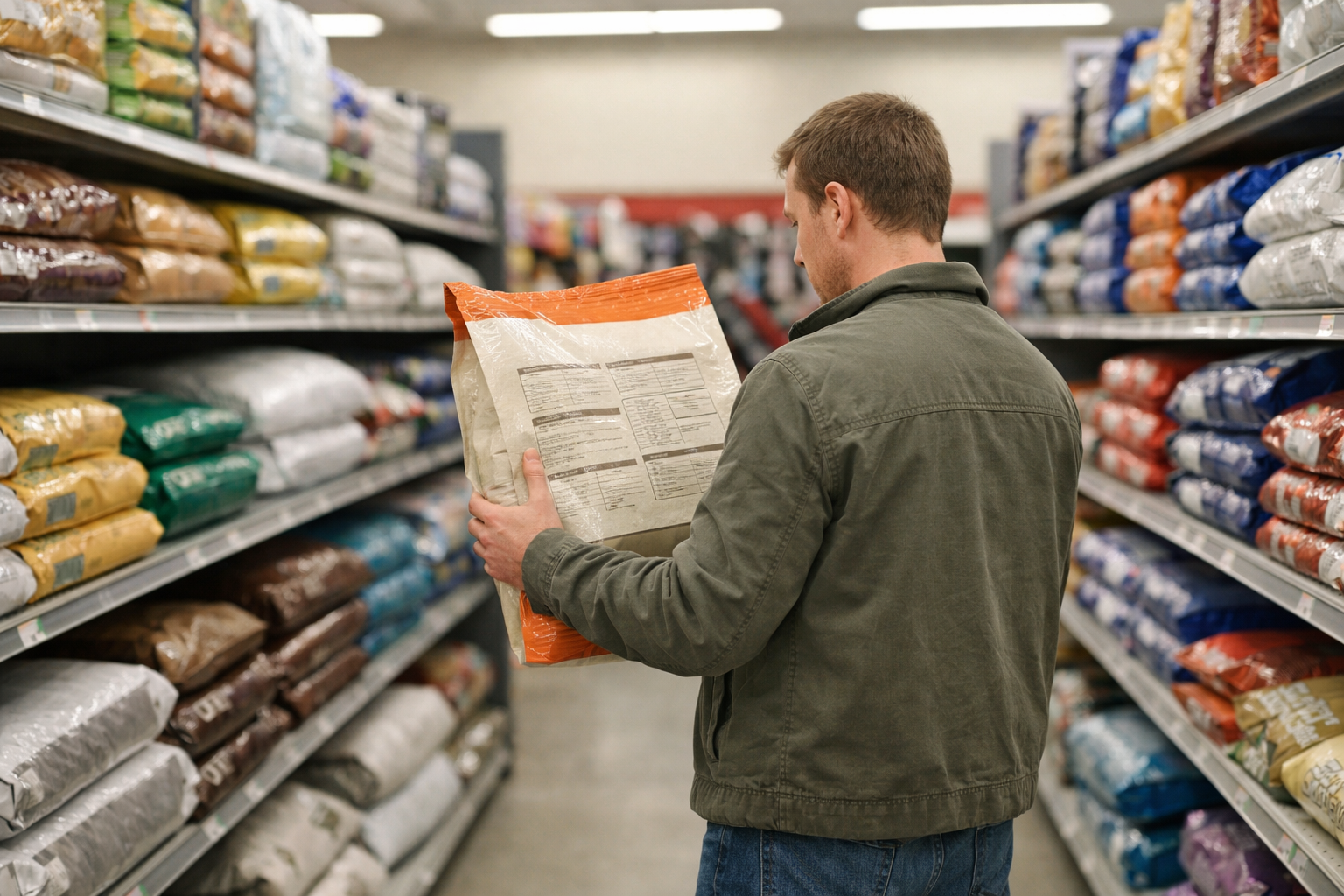
If you’ve ever stood in the pet food aisle squinting at a dog food bag like it’s written in another language… you’re not alone. Dog food labels are technically regulated, but that doesn’t mean they’re written for actual humans. They’re packed with buzzwords, sneaky marketing terms, and ingredient lists that raise more questions than they answer.
The good news? Once you know what actually matters—and what’s mostly fluff—reading a dog food label gets a whole lot easier. You don’t need to memorize every scientific term or become a canine nutrition expert. You just need to know where to look and what to prioritize.
Let’s break it all down in plain English.
Start With the Ingredient List (But Read It Smartly)
Here’s a quick overview of common ingredients and where they stand on the “should I or shouldn’t I give this to my dog” spectrum. We’ll go over everything in a bit more detail below.
| Ingredient | Risk Level | Why It Matters |
|---|---|---|
| Chicken | ✅ Low Risk | Whole, named animal protein that provides essential amino acids |
| Chicken Meal | ✅ Low Risk | Concentrated protein source with moisture removed before processing |
| Sweet Potatoes | ✅ Low Risk | Whole-food carbohydrate rich in fiber, vitamins, and antioxidants |
| Brown Rice | 🟡 Moderate Risk | Easily digestible grain that provides energy when used appropriately |
| Salmon Oil | ✅ Low Risk | Rich source of omega-3 fatty acids that support skin, coat, and joints |
| Poultry By-Product | 🟡 Moderate Risk | Can be nutritious, but quality varies when the source isn’t specified |
| Red 40 | 🔴 Higher Risk | Artificial coloring with no nutritional value; unnecessary for dogs |
| BHA | 🔴 Higher Risk | Synthetic preservative with safety concerns; natural alternatives exist |
| Corn Gluten Meal | 🟡 Moderate Risk | Plant protein concentrate that boosts protein numbers without meat |
| Wheat Middlings | 🟡 Moderate Risk | Low-cost milling by-product with limited nutritional value |
Tip: No single ingredient tells the whole story. Ingredient quality, sourcing, and overall formulation matter just as much as what appears on the label.
The ingredient list is usually where pet parents head first—and for good reason. Ingredients are listed by weight before cooking, which is important to understand.
What That Really Means
Fresh meats (like chicken or beef) contain a lot of water. Once cooked, they lose much of that weight. So a food that lists “chicken” first isn’t automatically higher in protein than one that lists “chicken meal.”
That doesn’t make fresh meat bad. It just means you need context.
Ingredients That Matter Most
Here’s what you generally want to see toward the top of the list:
✔ Named animal proteins
Examples:
Chicken
Beef
Turkey
Salmon
Named proteins are specific and traceable. “Meat” or “animal protein” without a source? Not so much.
✔ Meat meals (yes, really)
Chicken meal, turkey meal, beef meal—these are concentrated protein sources because the water has already been removed. When they’re clearly named, they’re not something to fear.
While we’re on the topic of proteins, here’s a handy comparison chart to help you choose the best option for your dog:
| Protein Type | What It Means | Why It Can Be Good | Watch Outs |
|---|---|---|---|
| Named Fresh Meat (e.g., chicken, beef, turkey) |
Whole animal protein listed by species; contains natural moisture before cooking | A clear, recognizable protein source that provides essential amino acids | Because it’s weighed before cooking, it can “shrink” on the list once moisture cooks out |
| Named Meat Meal (e.g., chicken meal, turkey meal) |
Rendered protein with most moisture removed before it’s added to the recipe | Often a more concentrated protein source than fresh meat; can support higher protein content | Quality depends on sourcing and manufacturing standards (brand transparency matters) |
| By-Products (named or unnamed) |
Nutrient-dense parts beyond muscle meat; may include organs and other tissues | Can be nutritious and provide natural vitamins and minerals when clearly sourced | “Unnamed” by-products are harder to evaluate; quality can vary widely |
| Unspecified “Meat” or “Animal” Ingredients (e.g., meat meal, animal fat) |
Protein/fat sources not tied to a specific animal | Sometimes used to keep formulas consistent across batches | Less transparency; can be a red flag for inconsistent sourcing or lower quality |
| Plant Protein Boosters (e.g., corn gluten meal, pea protein) |
Concentrated plant-based proteins that raise the overall protein percentage | Can play a supporting role in a balanced formula, especially for fiber and energy | Can make a food look “high protein” even if the meat content is modest |
Quick tip If you see named meat and/or named meat meal near the top, that’s usually a good sign. “Unnamed” animal ingredients are where you’ll want to look closer.
✔ Whole food carbs (in moderation)
Dogs don’t need carbs the way humans do, but they aren’t inherently bad either. Look for:
Sweet potatoes
Brown rice
Oats
Barley
These provide energy and fiber without being nutritionally empty.
✔ Healthy fats
Fats are essential for skin, coat, and overall health.
Chicken fat
Fish oil
Bonus points if the source is named.
Ingredients to Avoid (or at least limit)
Not every “bad” ingredient is universally terrible, but some deserve closer scrutiny.
Vague or Unnamed Proteins
Meat by-products (without a source)
Animal fat
Poultry by-product (especially unnamed)
Named by-products (like “chicken by-product”) are at least transparent. Unnamed ones? That’s where quality becomes questionable.
Artificial Additives
Ideally, you want to avoid:
Artificial colors (Red 40, Blue 2, etc.)
Artificial flavors
Chemical preservatives like BHA, BHT, and ethoxyquin
Natural preservatives (mixed tocopherols, vitamin E, rosemary extract) are better. As for dyes, dogs don’t care what color their food is. They only care if it tastes good. So there’s ZERO reason for food to include dyes.
Excessive Fillers
Some fillers aren’t harmful, but they don’t bring much to the table nutritionally:
Corn gluten meal
Wheat middlings (also called millfeed)
Soy flour
A little isn’t the end of the world—but when these dominate the ingredient list, it’s usually a sign of cost-cutting.
The Guaranteed Analysis: Useful, But Limited
The Guaranteed Analysis tells you the minimum or maximum percentages of key nutrients:
Crude protein (minimum)
Crude fat (minimum)
Crude fiber (maximum)
Moisture (maximum)
Why “Crude” Matters
“Crude” doesn’t mean low-quality—it just refers to how nutrients are measured. Still, this section doesn’t tell you:
Protein quality
Digestibility
Where those nutrients come from
Two foods can show the same protein percentage but perform very differently in your dog’s bowl.
Dry Matter Basis (Optional, But Helpful)
If you’re comparing wet food to kibble, moisture skews the numbers. Converting to dry matter helps—but if that sounds like homework, don’t stress. Focus on ingredients first.
The AAFCO Statement
This tiny line is easy to overlook, but it matters.
Look for wording like:
“Formulated to meet the nutritional levels established by AAFCO Dog Food Nutrient Profiles…”
This tells you the food is complete and balanced for a specific life stage:
Growth (puppies)
Adult maintenance
All life stages
If it says the food is intended for “intermittent or supplemental feeding only,” it’s not meant to be your dog’s main diet.
Marketing Terms That Sound Great (But Don’t Mean Much)
Pet food marketing is… creative. Here’s how to translate the big claims.
“Natural”
This has a legal definition, but it doesn’t guarantee quality. It mostly means no artificial colors, flavors, or preservatives.
“Holistic”
Sounds impressive. Has no official definition.
“Premium” or “Super Premium”
Pure marketing. No regulation.
“Grain-Free”
Not inherently better. Some dogs do great on grains. Others don’t. What matters is overall formulation, not buzzwords.
“Human-Grade”
This one can matter—but only if the company can back it up. True human-grade food must be made in a facility licensed for human food production. Some examples of companies that can back up that claim include:
Want to explore fresher food options?
Curious how delivery-style dog food stacks up? We break down the pros, cons, and standout options in our guide to the 10 best dog food delivery services .
Watch Out for Ingredient Splitting
This is a sneaky labeling trick.
Instead of listing:
Corn
You’ll see:
Ground corn
Corn gluten meal
Corn flour
Individually, they appear lower on the list—but together, they may make up a large portion of the food.
Same trick, different packaging.
The Brand Matters More Than the Buzzwords
Dog food labels don’t tell you everything. Some of the most important questions aren’t printed on the bag:
Does the company employ veterinary nutritionists?
Do they run feeding trials?
Where are their foods made?
How transparent are they about sourcing?
A clean ingredient list is great—but it’s only part of the picture.
So… How Do You Choose Without Losing Your Mind?
Here’s the simplified version:
Focus on:
Named animal proteins
Clear fat sources
Reasonable carb choices
AAFCO nutritional adequacy
Transparency from the brand
Worry less about:
Trendy marketing terms
Whether a food is grain-free or not
Chasing the highest protein number possible
And most importantly—watch your dog. Shiny coat, healthy stools, good energy, and eagerness to eat tell you more than any label ever will.
How to Read a Dog Food Label in 60 Seconds
| Step | What To Look For | Why It Matters |
|---|---|---|
| 1) Check the AAFCO Statement | “Complete and balanced” for your dog’s life stage (puppy, adult, senior, all life stages) | Confirms it’s intended as a main diet—not just a topper or treat |
| 2) Scan the first 5 ingredients | Named meats/meals + recognizable whole foods | This is where most of the recipe’s “core” is coming from |
| 3) Look for clear fat sources | Chicken fat, salmon oil, fish oil (named sources) | Quality fats support skin, coat, and energy—especially omega-3s |
| 4) Watch for vague ingredients | “Animal fat,” “meat meal,” “poultry by-product” (unnamed) | Less transparency makes it harder to judge consistency and quality |
| 5) Spot the “extra” additives | Artificial dyes/flavors, chemical preservatives (BHA/BHT) | They add appearance and shelf life—not nutrition |
| 6) Sanity-check the Guaranteed Analysis | Protein/fat/fiber that fits your dog’s needs | Percentages help, but don’t replace ingredient quality and digestibility |
Reality check If your dog is thriving (good energy, healthy stools, shiny coat), that matters just as much as the label.
The Bottom Line
Dog food labels aren’t designed to be intuitive—but once you know how to decode them, they stop being intimidating. You don’t need to find the “perfect” food. You just need a well-formulated, balanced option that works for your dog.
If you ever feel overwhelmed, remember this: a thoughtful choice made with good information will always beat one made based on flashy packaging.
Your dog doesn’t care about buzzwords. They care about how they feel—and now you’re better equipped to make sure they feel their best.
Keep your dog safe while they explore with top GPS collars and virtual fences. From advanced tracking to adaptable boundaries, find the perfect solution here!
10 Best Dog Food Delivery Services of 2024
You know that choosing the right dog food is absolutely vital to your pup’s health and happiness, but with busy schedules, getting top-quality meals can be a challenge.
Best Self-Cleaning Litter Boxes for Cats
We’ve reviewed the top self-cleaning litter boxes to help you find the perfect one for your cat. We’ve ranked the best options based on performance, design, and ease of use.
Author
-
Hi there! I'm Nicole! I've been a pet owner for most of my adult life and an animal lover for much longer than that. I grew up with a wonderful German Shepherd named Jake, who I loved SO much that I named my son after him. When I'm not writing for DogVills or my own site, Pretty Opinionated , I love spending time with my teenager (when he actually lets me), my Pharaoh Hound Freya and a slew of cats. I'm also an avid reader AND a total TV fanatic. If you'd like to learn more about me, feel free to check out my Linked In profile.